
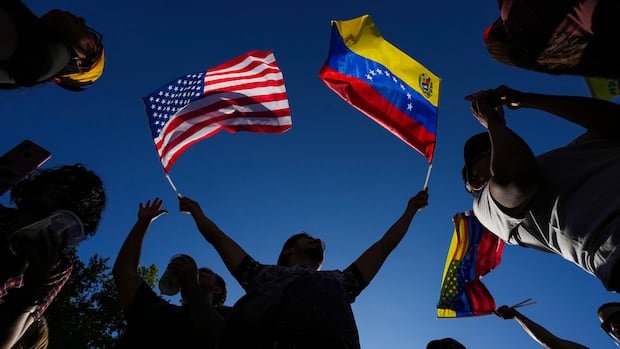

Just shortly after a military operation by the United States in Venezuela and the capture of President Nicolás Maduro, Katie Miller, the wife of a top adviser to President Donald Trump, issued a clear caution to Canada on social media. She emphasized that the U.S. no longer requires anything from Canada and declared the end of free trade.
This message echoes sentiments expressed by others close to Trump and the President himself. The focus has shifted to the potential access the United States could gain to Venezuela’s vast reserves of heavy crude oil, similar to Western Canada’s production. As Canada prepares to assess the Canada-U.S.-Mexico Agreement (CUSMA), questions arise about how the developments in Venezuela might impact Canada’s negotiating position.
Experts and former officials interviewed by CBC’s The House delved into the feasibility of increasing Venezuelan oil production and the implications for future trade discussions. RJ Johnston, the director of energy and natural resources policy at the University of Calgary, highlighted the challenges facing U.S. oil companies considering re-entry into Venezuela due to the country’s deteriorating oil sector and infrastructure.
The U.S. government is urging oil executives to reinvest in Venezuela promptly and commit significant capital to revive the country’s oil industry. Despite concerns raised by the incursion, Prime Minister Mark Carney remains unconcerned about heightened oil production from Venezuela, citing the cost-effectiveness, cleanliness, and lower-risk profile of Canadian oil.
Following insights from Kate Kalutkiewicz, a former official in Trump’s administration, and Fen Osler Hampson, co-chair of the Expert Group on Canada-U.S. Relations, the events in Venezuela are seen as a signal of Trump’s efforts to diversify trade partnerships and enhance negotiation leverage. The strategic move in Venezuela underscores the U.S. prioritization of the Western Hemisphere in trade and security matters.
Regarding the future of CUSMA, Laura Dawson of the Future Borders Coalition emphasized the complexity of potential concessions during trade negotiations and the impact on domestic industries and livelihoods. Despite uncertainties surrounding the demands set by the U.S., there is confidence in the resilience of the North American economic relationship and the continuity of CUSMA.
In conclusion, while the situation in Venezuela adds a new dimension to Canada-U.S. trade dynamics, the broader trade talks and the fate of CUSMA remain complex and multifaceted. The evolving trade landscape underscores the importance of strategic negotiations and economic partnerships in the North American region.