
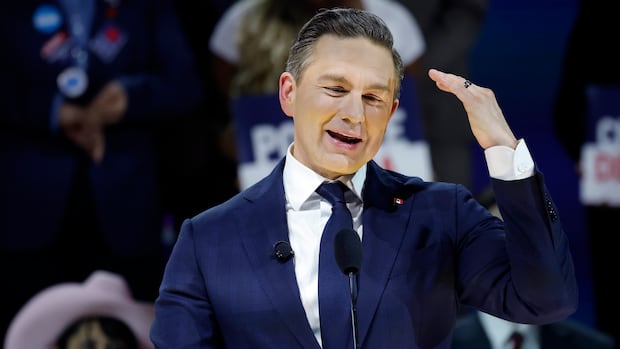

To grasp the ascent and subsequent stagnation of Pierre Poilievre, it’s helpful to examine two surveys taken approximately three and a half years apart.
In September 2022, shortly after Poilievre was named the Conservative leader, Abacus Data revealed that 35 percent of Canadians were inclined to support Poilievre’s party, placing the Conservatives five points ahead of the Liberals. While Canadians weren’t entirely sold on Poilievre — 34 percent expressed a negative impression of him, while 29 percent had a favorable view — he was at least viewed more favorably than his Liberal counterpart.
By the fall of 2022, the Liberal government faced disapproval from 49 percent of Canadians, with only 37 percent expressing approval. A negative view of the then-prime minister, Justin Trudeau, was held by 48 percent of Canadians, while just 33 percent viewed him positively.
Fast forward to late January 2026 and a new survey from Abacus.
Support for the Conservative Party has actually risen by four points since September 2022. Now, 38 percent of Canadians report having a positive impression of Poilievre.
However, the percentage of Canadians holding a negative view of the Conservative leader has also climbed — Abacus shows that 44 percent of Canadians view Poilievre unfavorably. Moreover, public opinion about the government has shifted significantly.
Currently, 54 percent of Canadians approve of the federal government’s performance, while only 31 percent disapprove. Fifty-three percent have a favorable impression of the prime minister, Mark Carney, compared to just 30 percent who view him negatively.
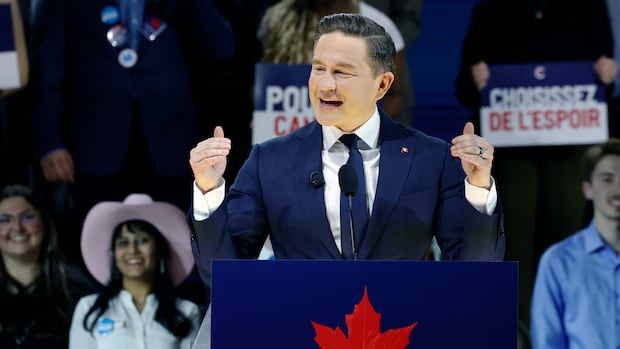
Conservative Leader Pierre Poilievre focused on affordability, opportunity, and outlined his governance approach during a significant speech at the party’s national convention in Calgary.
Despite 39 percent of Canadians still leaning towards a Conservative vote, had an election occurred in late January, 43 percent would have chosen the Liberal party.
When the Conservatives appointed Poilievre in September 2022, the timing seemed ideal for him. From that point until about a year ago, it appeared he was well-suited for the moment.
However, that moment has shifted.
During the weekend when Conservative Party members reaffirmed their commitment to Poilievre, there was hope that the moment could still return to him.
Poilievre maintains his stance with ‘hope’
The address Poilievre gave in Calgary on Friday night portrayed the Conservative leader in a somewhat altered light, yet it didn’t present a drastically different version of himself. He continued to voice his opposition to “identity politics” and “political correctness,” although he appeared more self-assured and optimistic — with “hope” being the central theme of his speech.
Nonetheless, this was not a significant change from the Poilievre Canadians observed in 2024 or during the 2025 election. A shift had not been anticipated.
Poilievre would likely contend that many of the issues he highlighted in 2024 remain relevant today — including the cost of living, housing affordability, and crime. He has consistently articulated his beliefs and perspective on politics, especially regarding his foundational view that government spending and regulations generally lead to more problems than solutions.
-
Pierre Poilievre sails through leadership review as Conservatives deliver a strong endorsement
-
The Conservative Party is overhauling its policy playbook. Here’s what’s changing
One area where Poilievre could benefit from greater clarity is regarding Canada’s relationship with the United States — during last year’s campaign, he appeared less inclined than Carney to advocate for a break from the past. However, radically altering his image at this stage would be quite challenging.
If Conservative Party members have chosen to remain loyal to Poilievre, the next question is whether all members of the Conservative parliamentary group will do the same.
Poilievre had only just begun his leadership in September 2022 when Alain Rayes opted to serve as an Independent. This departure had minimal impact on Poilievre’s position, but a series of resignations last year — Chris d’Entremont, Matt Jeneroux, and Michael Ma — raised more serious concerns about Poilievre’s leadership.
Further defections could potentially grant the Liberals a majority in the House of Commons, while also undermining Poilievre’s political standing to the extent that even remaining Conservative members might question his leadership suitability.
Will persistence prevail?
For the time being, Poilievre appears determined to maintain his approach from the past three and a half years — concentrating on affordability, housing, and resource development while asserting that Carney, similar to his predecessor, has not fulfilled his commitments.
Having secured 41.3 percent of the popular vote last spring, this strategy makes sense for Conservatives. If Poilievre can unite the Conservative base, and more Canadians become disillusioned with the Carney administration, this could provide him the opportunity to reclaim momentum and achieve electoral success.
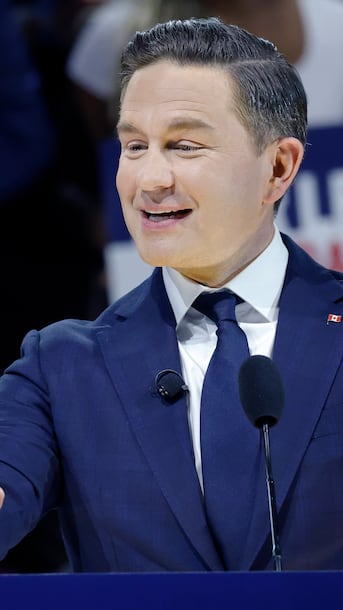
Conservative Leader Pierre Poilievre received the backing of delegates with 87.4 percent of the vote, which a Conservative Party representative described as ‘an overwhelming majority.’
However, Poilievre may face even greater challenges if the new era that began last January not only elevated a new prime minister but also reframed perceptions of his leadership — a perspective perhaps captured by the New York Times headline this past weekend, which noted that Canada’s Conservatives had granted their “Trump-esque” leader another opportunity.
In this current context, Poilievre’s populism could be as much a hindrance as a help. Abacus Data’s David Coletto noted on Monday that approximately four in ten Canadians perceive Poilievre as echoing Trump — and as long as the Conservative leader remains “highly polarizing, centre-left voters are incentivized to consolidate behind alternatives rather than splitting their votes.”
Anyone who has closely followed Canadian politics over the past year would be cautious about forecasting the upcoming year. The moment may still return to Poilievre.
Yet, the concern for Conservatives and their leader is that the momentum seen from September 2022 to January 2025 may not be returning.