
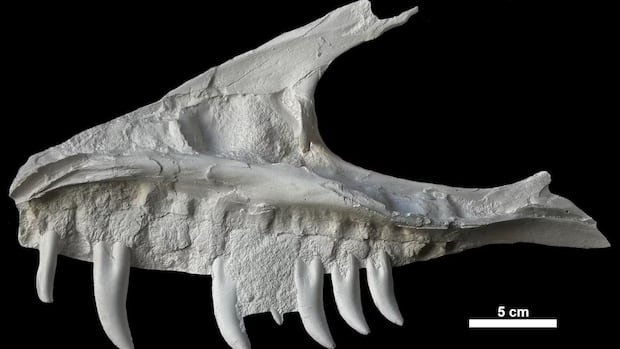

A recent study reveals that a dinosaur skull unearthed at a British Columbia campground belonged to a lighter and swifter tyrannosaur species compared to the well-known T. rex. Researchers from the University of Alberta examined a partial skull impression dating back 76 million years and identified it as a Gorgosaurus, shedding new light on this ancient creature that once inhabited Western Canada. According to lead author Colton Coppock, distinct characteristics on the impression helped pinpoint the species.
The Royal Tyrrell Museum in Alberta notes that Gorgosaurus could grow up to nine meters in length. The journey to identifying this dinosaur began in 2017 when Rick Lambert, a resident of B.C., stumbled upon an unusual rock at a campground in Tumbler Ridge, near the Alberta border. Lambert’s fossil-hunting background from his childhood in England, coupled with a squirrel’s guidance, led to the discovery of B.C.’s first tyrannosaurus skull.
Upon examination by a paleontologist from the Tumbler Ridge Museum Foundation, it was confirmed that Lambert had found a significant fossil. The museum curator, Eamon Drysdale, highlighted the rarity of bone material in the region, emphasizing the preservation of the original impression within a sandstone block under controlled conditions.
The partial skull imprint included the maxilla of the dinosaur, with most of the bone having eroded but leaving a detailed cast revealing unique features. Coppock and his team were able to compare the cast with other Gorgosaurus skull bones, identifying similarities and confirming the species. Gorgosaurus, a well-documented tyrannosaur in Alberta, lived around 76 million years ago, predating its famous relative, the T. rex.
The researchers uncovered clues linking the partial skull to Gorgosaurus, such as distinctive bone sutures and jaw features. Analysis of the teeth suggested the dinosaur was a juvenile at the time of its demise. Coppock also revealed that Gorgosaurus had a wider geographical range than previously thought, spanning from northern British Columbia to northern Montana, covering approximately 198,000 square kilometers.
This discovery hints at British Columbia’s potential as a hotspot for future dinosaur findings. Coppock emphasized that B.C. is emerging as a new frontier for dinosaur research. Lambert, reflecting on his find, expressed awe at the enduring history of life on our planet, highlighting the significance of such discoveries in understanding Earth’s past.