
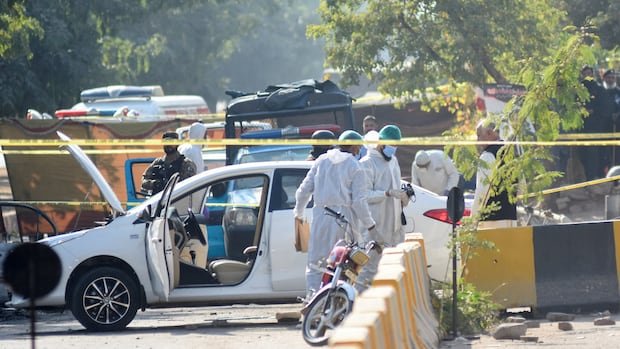

Pakistan’s Minister of Interior reported that a suicide bomber detonated explosives near a police vehicle outside the district court’s gate in Islamabad, the capital city, causing 12 fatalities and injuring 27 individuals. The bomber attempted to access the court premises but redirected the attack towards a police vehicle, as stated by Mohsin Naqvi, the Interior Minister. The blast, attributed to a suicide bomber by police investigators, resonated across kilometers and occurred during a busy time when the court area is usually packed with visitors.
The Jamaat-ul-Ahrar group, a splinter faction of the Pakistani Taliban, claimed responsibility for the assault, according to messages from the group’s leader, Omar Mukaram Khurasani. However, another prominent figure within the group, Sarbakaf Mohmand, disowned any ties to the attack. Following the demise of Jamaat-ul-Ahrar’s leader in Afghanistan in 2022, the group separated from the Pakistani Taliban, with some members rejoining while others maintained distance, indicating internal discord among the insurgents. The TTP, distinct yet allied with the Afghan Taliban, continues to show conflicting affiliations.
Jamaat-ul-Ahrar, known for previous minor attacks, demonstrated its capability to strike the Pakistani capital, adding to the challenges faced by the government amidst a resurgent Pakistani Taliban, border tensions, and a delicate ceasefire with Afghanistan. Initial reports from Pakistani state media and security officials pointed to a car bomb as the cause of the explosion.
Without presenting evidence, Naqvi implicated “Indian-backed elements and Afghan Taliban proxies” associated with the Pakistani Taliban in the attack. He affirmed that authorities are thoroughly investigating all aspects of the incident. Refuting the allegations, Randhir Jaiswal, the spokesperson for India’s Ministry of External Affairs, dismissed them as unfounded. The international community, including the United States, China, Saudi Arabia, Qatar, Turkey, and the United Nations, condemned the attack.
The incident resulted in chaos outside the court, with police securing the area as smoke billowed into the sky. Most casualties were bystanders or individuals visiting the court for appointments, as per Islamabad police. Amidst the commotion, ambulances rushed to assist over a dozen severely wounded individuals seeking help. Naqvi confirmed the suicide nature of the attack through the discovery of the attacker’s severed head nearby and CCTV footage identifying the bomber, clarifying that the death toll of 12 did not include the assailant.
In a separate incident, Pakistani security forces thwarted an assault by militants attempting to take cadets hostage at an army-run college overnight. The confrontation in a northwestern province involved a suicide car bomber and five other Pakistani Taliban members targeting the facility. The military operation resulted in the elimination of two militants, while three others sought refuge within the compound before being contained in an administrative block, leading to an ongoing clearance operation.
The TTP denied involvement in the college attack, exemplifying the group’s emboldenment following the Taliban’s control of Kabul in 2021, with many leaders and fighters finding sanctuary in Afghanistan. Pakistan has witnessed a surge in militant activities, with the deadliest school attack occurring in 2014 when Taliban gunmen massacred 154 individuals, predominantly children, in Peshawar. Recent tensions between Pakistan and Afghanistan have escalated, with cross-border clashes and failed peace talks due to Kabul’s reluctance to ensure militant groups refrain from using Afghan territory against Pakistan.
The rewritten text follows accurate information, optimized for search engines, and maintains a reader-friendly tone.