
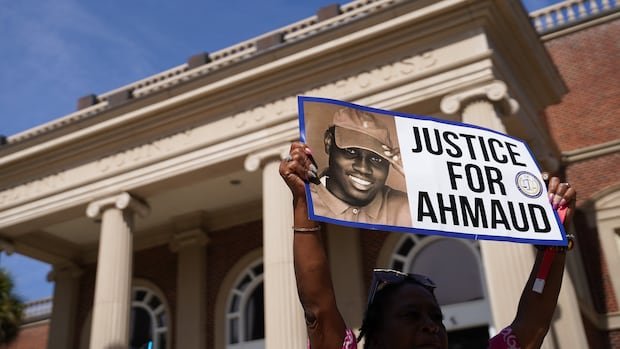

A U.S. federal appeals court has affirmed the hate crime convictions of three Caucasian men who pursued Ahmaud Arbery in their Georgia neighborhood with trucks before one of them fatally shot the African American man. The 11th U.S. Circuit Court of Appeals’ three-judge panel took more than a year to make the ruling after the defendants’ lawyers requested the case to be overturned in March 2024, arguing that the men’s history of racist text messages and social media posts did not prove they targeted Arbery based on his race.
Federal prosecutors used these posts and messages in 2022 to convince a jury that Arbery’s murder was driven by racial animosity. Judge Elizabeth L. Branch, in the appellate panel’s opinion, stated that prosecutors demonstrated at the trial that each defendant harbored deep-seated prejudices, and the evidence was adequate for a reasonable juror to conclude that Arbery’s race was the decisive factor in the fatal neighborhood pursuit.
Even if the hate crime convictions were overturned by the appeals judges, the trio would not have been immediately released from prison as they are already serving life sentences for murder following their convictions in a Georgia state court.
The incident occurred when father and son, Greg and Travis McMichael, armed themselves and chased 25-year-old Arbery in a pickup truck after seeing him running in their neighborhood near Brunswick on February 23, 2020. A neighbor, William (Roddie) Bryan, joined the pursuit and recorded a video of Travis McMichael shooting Arbery at close range.
Arrests were not made for over two months until Bryan’s video of the killing surfaced online. The Georgia Bureau of Investigation assumed control of the case from local authorities as public outcry over Arbery’s death merged with a nationwide protest against racial injustice.
All three men were found guilty of murder by a state court in late 2021. Following a second trial in U.S. District Court in early 2022, a jury convicted them of hate crimes and attempted kidnapping.
In their federal appeals, Bryan and Greg McMichael’s attorneys criticized the prosecutor’s use of over two dozen social media posts and text messages, as well as witness testimony, showing the men using racist language or derogatory remarks about Black individuals. Bryan’s lawyer, Pete Theodocion, argued that these statements were so offensive that prosecutors swayed the jury without demonstrating a racist intent to harm Arbery himself.
Greg McMichael’s lawyer, A.J. Balbo, maintained that his client initiated the pursuit because he mistakenly believed Arbery was a fleeing criminal, based on security camera footage showing Arbery entering a nearby under-construction home in previous months. However, the 11th Circuit judges dismissed these claims, citing no evidence of Arbery committing any crimes in the neighborhood, being unarmed, and possessing no stolen items when he was killed.
Travis McMichael’s attorney, Amy Lee Copeland, did not dispute her client’s racist motivation, but rather based her appeal on legal technicalities. She argued that prosecutors failed to prove that the streets where Arbery was killed were public roads, as stated in the indictment used for charging the men, a claim that the 11th Circuit rejected.
The trial judge sentenced both McMichaels to life imprisonment for their hate crime convictions, with added time – 10 years for Travis McMichael and seven years for his father – for displaying firearms during violent acts. Bryan received a 35-year hate crime sentence, partly due to being unarmed and for preserving the vital cellphone video as evidence.