
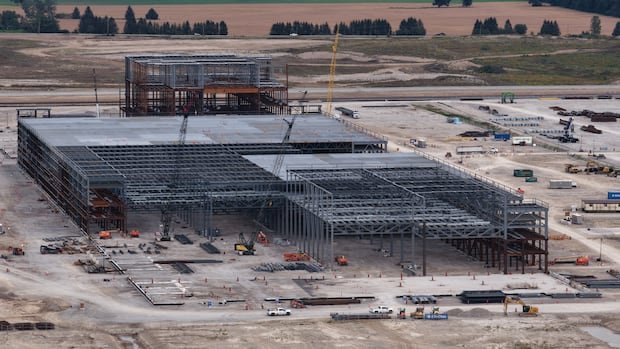

The federal and provincial governments have invested large sums in the growth of the electric vehicle (EV) industry. However, significant EV and battery projects in Ontario, Quebec, and British Columbia have faced delays, cancellations, suspensions, substantial changes, and even bankruptcy due to weaker-than-expected demand. The most recent setback is Volkswagen’s PowerCo battery plant in St. Thomas, Ontario, with production now postponed until 2029 due to evolving market demand.
Critics are questioning whether Canada overestimated the speed of EV market expansion. Some argue that the demand may never reach the levels necessary to support the intended scale of battery production that governments aimed to attract. On the other hand, some believe these setbacks are just temporary obstacles in the ongoing transition to electrification.
Grieg Mordue, a former Toyota executive and retired McMaster University professor, highlights two issues with Canada’s EV investment strategy concerning scale and location. When the St. Thomas project was revealed in 2023, PowerCo claimed the plant would eventually produce enough battery cells for approximately one million EVs annually. However, Mordue points out inefficiencies in this plan, considering Volkswagen’s main assembly operations are in the southern United States and Mexico, making long-distance battery transportation necessary.
Despite these challenges, Volkswagen emphasizes that the St. Thomas plant remains a crucial component of its North American battery strategy. The delay provides an opportunity to incorporate newer battery technology and adjust production to match evolving demand. Additionally, the postponement could result in reduced taxpayer subsidies as incentives are tied to production levels.
While some express concerns about the current EV market demand, others suggest that investments like the St. Thomas plant are long-term commitments. The shift towards EVs is viewed as a transition period, and signs indicate market recovery, with an increase in battery-only EV registrations. Maintaining relevance in the evolving auto industry and ensuring competitiveness are cited as key reasons for Canada’s investment in EV and battery manufacturing.
The article closes with discussions on the global EV battery market, future industry developments, and differing opinions on the sustainability of current government policies and incentives in the EV sector.