
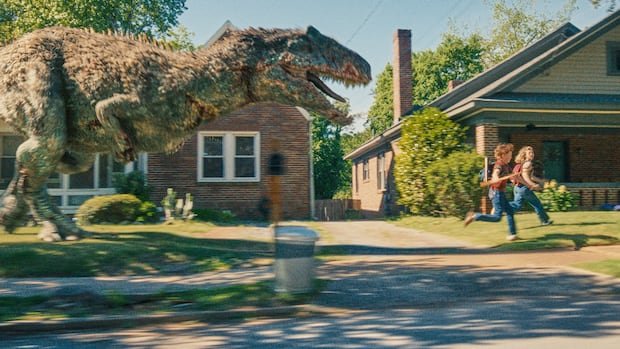

A massive serpent-like entity emerges from a nearby pool. Winged reptiles pursue a family along their driveway. Two colossal, furry creatures lean against a building and engage in intimate behavior – all scenes from the latest film, “The End of Oak Street,” capitalizing on dinosaur nostalgia akin to “Jurassic Park.”
Despite Hollywood’s long-standing portrayal of prehistoric creatures, the dinosaurs in this movie differ significantly from their predecessors, reflecting a much-anticipated update based on paleontological insights. In an interview with CBC News, experts discuss the accuracy of the movie’s depiction of feathers and fauna, shedding light on where filmmakers have taken creative liberties to fill gaps in the incomplete fossil record, which still raises fundamental questions.
One intriguing aspect raised is the depiction of dinosaur mating in the film. Paleontologist Victoria Arbour from the Royal B.C. Museum commended the film for featuring abundant feathers on dinosaurs, a departure from the scaly creatures commonly seen in recent “Jurassic World” movies.
The evolution in dinosaur depictions in movies has been slow to align with scientific discoveries. The link between dinosaurs and birds has been suspected since the early days of evolution theory. Recent fossil findings since the 1990s have significantly bolstered the evidence of feathered non-avian dinosaurs. Notably, the discovery of Sinosauropteryx prima in China, the first non-avian dinosaur with clear feather evidence, marked a pivotal shift in how dinosaurs are imagined.
“The End of Oak Street” takes a bold approach by prominently featuring feathered dinosaurs, deviating from past film portrayals. The decision to depict an Allosaurus with feathers is considered plausible by experts due to its evolutionary proximity to birds. However, some creatures in the film, like the smaller feathered dinosaur resembling an Elaphrosaurus, appear to be more loosely based on scientific evidence.
Certain animals in the film are more speculative, such as the giant legless aquatic creature, which lacks a fossil record counterpart according to experts. Additionally, the portrayal of furry sauropods in the film, although appealing to the audience, may not align with scientific reality due to their massive size and heat regulation challenges.
The film also delves into depicting dinosaur mating behavior, a topic that remains shrouded in mystery due to the scarcity of preserved soft tissue in fossils. The reproduction habits of dinosaurs, including their mating rituals, remain largely speculative, with limited direct evidence available to researchers. Despite the creative liberties taken in the film, experts acknowledge the challenges of accurately portraying dinosaur behavior without concrete fossil evidence.
Ultimately, the film’s depiction of dinosaur mating scenes, while speculative, does not veer into impossibility according to experts. The movie aims to showcase a broader perspective on dinosaurs beyond their hunting instincts, offering a glimpse into their potential social and reproductive lives.