
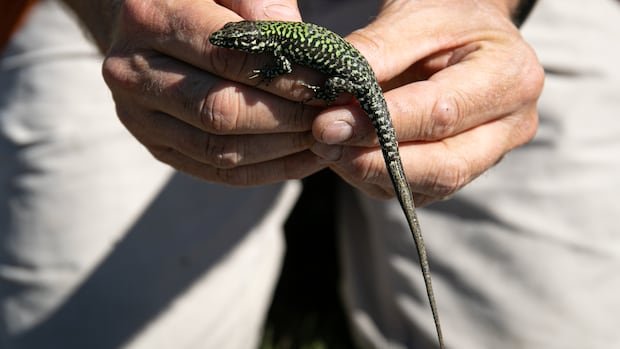

Tracy Menzies had been battling with slugs in her backyard garden, consistently losing out on the harvest in previous years. However, this season, her strawberries flourished beautifully. The reason behind the slugs’ decline seems to be the rise of the invasive European wall lizard, known for swiftly spreading and consuming various creatures like insects, spiders, and slugs.
Living near the Gorge Waterway in Saanich, Menzies observed a surge in the number of wall lizards in her yard recently, scurrying around her garden and underfoot. She believes that the lizards are likely feasting on the slugs, given the absence of slugs in her yard coinciding with the appearance of the wall lizards.
Gavin Hanke, curator of vertebrate zoology at the Royal B.C. Museum, estimates that there are approximately 800,000 to a million European wall lizards in British Columbia, primarily concentrated on Vancouver Island. Their rapid spread, reaching as far as Campbell River, about 220 kilometers north of Victoria, raises concerns about their potential environmental impact.
Hanke expresses worry about the lizards’ effect on the ecosystem, emphasizing their threat to invertebrate populations and native species. Biologist Nicholas Wong from the Invasive Species Council of B.C. notes the absence of official management programs to control the lizard population growth, highlighting the competition for food and habitat among native and European wall lizards.
The origin of the B.C. lizard population traces back to the intentional release of 12 lizards in 1970 after the closure of Rudy’s Pet Park in Central Saanich. The lizards thrive in the climate of Southern Vancouver Island, with their spread facilitated by various means, including hitchhiking on vehicles and materials.
While the wall lizards have provided some benefits like protecting Menzies’ strawberries, concerns about their unchecked proliferation remain. Suggestions to mitigate their spread include maintaining plain, well-kept gardens to deter their habitation. However, the collective effort of the community is essential to prevent re-infestation from neighboring properties.
Despite the challenges, Hanke acknowledges the futility of eradicating the lizards at this stage, attributing their presence to human-induced disruptions in the ecosystem. He warns against relocating the lizards to new areas to prevent further expansion and potential harm to surrounding ecosystems.
In essence, the invasion of European wall lizards on Vancouver Island poses a complex challenge with implications for the local environment and biodiversity. Efforts to manage their spread and mitigate their impact require a strategic and collaborative approach.