
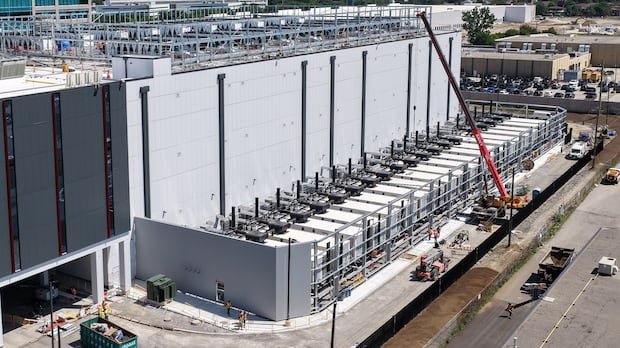

Ontario Premier Doug Ford unveiled the province’s fresh data center framework on Thursday, emphasizing the importance of keeping Canadians’ data within Canadian borders. The framework is built on three key principles: economic development, data protection and sovereignty, and community investment, and public trust.
During the announcement in Guelph, Ford highlighted that the new data center playbook aims to foster the economy of the future, driving billions in economic growth, boosting tax revenues, and generating thousands of new jobs, all while ensuring compliance with regulations.
Under the framework, data centers will be required to cover the full cost of their electricity consumption, promoting self-sufficient power generation and establishing a distinct rate category for large new data centers that is higher than the existing industrial rate programs. This measure aims to avoid burdening Ontario families with additional costs.
Contrary to offering financial incentives, the province’s focus is on creating a conducive environment for data centers to thrive. The framework is expected to play a critical role in supporting the province’s artificial intelligence (AI) strategy, forecasted to deliver significant economic benefits, including a projected $122 billion in economic growth by 2035 and the annual creation of 17,000 new jobs.
The announcement coincides with ongoing discussions among municipalities in Ontario regarding moratoriums on data centers, with Oakville recently implementing a one-year pause and Mississauga set to vote on a similar moratorium in September.
Green Party of Ontario leader Mike Schreiner has been vocal about advocating for a halt on new data centers, expressing concerns about the disproportionate benefits corporations receive compared to local communities. Schreiner’s call has been supported by Ilham Abdulkadir from the Wellington Water Watchers group, who highlighted the significant resource requirements of data centers, including land, energy, and water.
Recognizing the importance of sustainable practices, Ontario’s Economic Development Minister Vic Fedeli emphasized the prioritization of data centers with closed-loop systems to minimize water consumption, echoing Ford’s commitment to supporting builds with such environmentally friendly features.
While Ford defended the necessity of data centers for various community needs, Schreiner criticized the new playbook for lacking specific regulations and called for stronger measures to protect communities from potential adverse impacts of data centers. The Green Party continues to push for a moratorium until stringent regulations are in place to safeguard communities and ensure their control over data center developments.
In the Waterloo region, local officials are actively examining the impacts of data centers, with Coun. Colleen James leading efforts to prepare an information report for the Region of Waterloo council to better understand the economic and environmental implications of data center expansion. The report is slated for completion early next year.