
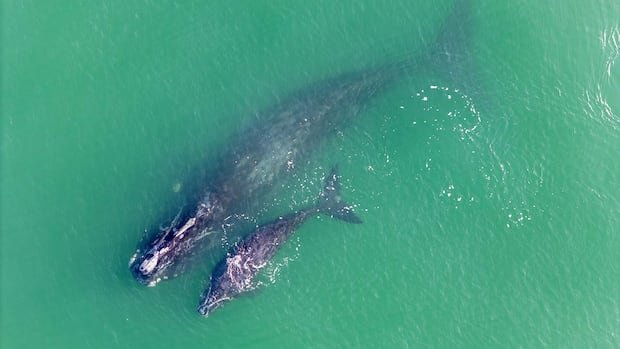

North Atlantic right whale experts on both sides of the border express cautious optimism following an increase in the number of new calves born this year. A total of 23 calves were welcomed during the calving season from November to April off the southeastern U.S., marking the highest number recorded since 2009. Amy Warren, scientific program officer at the New England Aquarium’s Anderson Cabot Center for Ocean Life, described the birth of 23 calves as a hopeful sign but emphasized the importance of their survival into adulthood to contribute to the endangered population of North Atlantic right whales, which currently stands at only 380 individuals based on the latest official estimate from 2024.
The decline in calving numbers over the past decade, with an average of 10 to 15 calves per year and a complete absence of known calves in 2018, contrasts with previous decades when around 20 new calves were born annually. The recent spike in births has raised questions among scientists, with Warren highlighting the potential role of maternal health, particularly in relation to food availability and consumption. North Atlantic right whales feed on specific plankton species, but climate change-induced shifts in their food sources have forced them to travel farther north to find sustenance, leaving them undernourished during crucial stages like calving and nursing.
Environmental stressors such as ocean noise, vessel traffic, ship collisions, and entanglement in fishing gear also pose significant threats to the well-being of North Atlantic right whales. To address these challenges, conservation efforts have been implemented in both Canadian and U.S. waters, including fishery closures and speed restrictions for marine vessels. Delphine Durette-Morin, an associate scientist at the Canadian Whale Institute, suggested that these protective measures may have contributed to the recent surge in calf births.
In addition to the higher number of calves born this year, researchers have observed a shorter interval between births for some mothers, indicating improved reproductive health among North Atlantic right whales. The positive trend of more frequent calving intervals among certain individuals, including experienced mothers like Ghost and Juno, offers hope for the accelerated growth of the whale population. Despite the positive developments, Warren emphasized that the overall population remains critically low and vulnerable to further decline, underscoring the need for sustained conservation efforts.
Looking ahead, experts like Durette-Morin stress the importance of continued vigilance and conservation measures to reverse the population decline of North Atlantic right whales. While this year’s increase in calf births is a positive development, significant and sustained growth is required to ensure the long-term survival of the species. The whales’ movement into Canadian waters, including their recent presence in the Gulf of St. Lawrence, signals both progress and ongoing challenges in the conservation of these iconic marine mammals.