
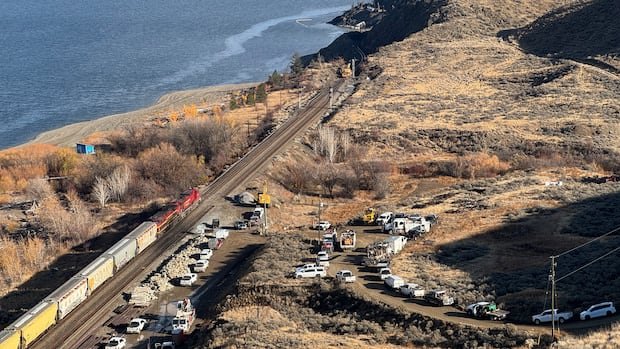

Authorities in British Columbia have reported that initial assessments indicate no contamination exceeding drinking water standards after 80,000 liters of fuel leaked into Kamloops Lake following a train derailment. The incident involving a Canadian Pacific Kansas City (CPKC) train occurred last Saturday, resulting in approximately 80,700 liters of aviation fuel spilling into the lake from 17 derailed rail cars.
Several communities, such as Savona, Tobiano, and Walhachin, which rely on the lake for their water supply, were immediately concerned. Despite many communities halting their water intake from the lake following the spill, officials confirmed on Friday that early water sample tests showed no adverse effects on drinking water in Savona, where 700 residents reside.
The Thompson-Nicola Regional District (TNRD) is awaiting further test results and assured residents in Walhachin that the risk to their Community Water System remains minimal. Recent water sample analyses revealed no contamination above safety thresholds for drinking water or aquatic life.
Efforts to mitigate the spill’s impact are underway, with specialists commencing fuel extraction from the water and removing a misaligned train car near the tracks. Authorities are also investigating the deaths of several birds, including Canada geese, found near the lake to determine if the fuel spill played a role.
A containment boom has been deployed in Kamloops Lake to contain any visible oil sheen, with surveillance flights confirming minimal fuel presence within the containment area. Ongoing water sampling continues to show levels below provincial drinking water guidelines, ensuring the safety of the water supply.
Private water operators drawing water from the lake, like in Tobiano, have been advised to conduct thorough inspections and contact their respective suppliers for any concerns. The Interior Health authority has cautioned the Frederick community against using water from the lake until further testing confirms the safety.
Environmental concerns persist as cleanup operations progress, with the cause of the derailment still under investigation. The CPKC has already removed four rail cars from the lake and is committed to completing the cleanup swiftly and safely.
Experts emphasize the importance of long-term monitoring to assess the downstream effects of the fuel spill. The incident serves as a reminder of the environmental vulnerabilities posed by such accidents and highlights the ongoing need for vigilance in protecting British Columbia’s ecosystems.