
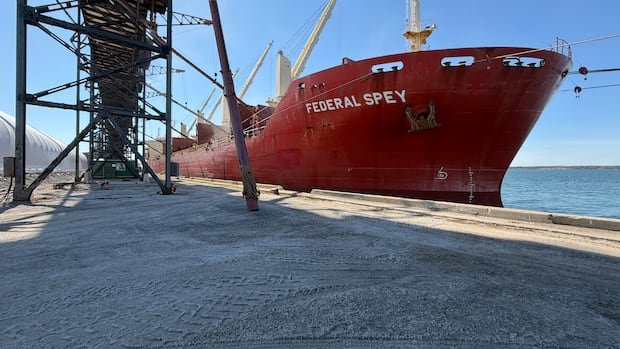

A vessel is scheduled to depart from the Port of Churchill this week, carrying the town’s first grain shipment in over five years. Loaded with approximately 30,000 metric tonnes of Canadian wheat, the ship will head to Europe, marking a significant achievement according to government officials.
During a ceremony at the port on Monday, Northern Affairs Minister and Member of Parliament for Churchill-Keewatinook Aski, Rebecca Chartrand, highlighted the importance of Churchill as a crucial northern gateway linking the Prairies, the Arctic, and the global markets. Following the onset of the COVID-19 pandemic, grain shipments from Churchill, which is Canada’s sole railway-accessible deep-water arctic port, were suspended, with the last shipment departing in 2020.
Arctic Gateway Group, the owner of the port and Hudson Bay Railway, announced in July the resumption of grain shipments for this summer. Recent activity at the port indicates a potential extension of its four-month shipping season.
Studies commissioned by Arctic Gateway and released earlier this month suggested the feasibility of year-round shipping without relying on costly icebreakers as sea ice continues to melt. Chartrand emphasized that investing in the port will enable Canada to access more markets amidst evolving global trade dynamics and changing relations with the U.S.
Arctic Gateway, a consortium comprising northern and First Nation communities, anticipates the most diverse shipping season in Churchill’s history. In addition to the grain shipment bound for Antwerp, Belgium, the port will handle its first-ever potash shipment this week, along with loading zinc concentrate and a resupply vessel destined for Nunavut.
Chris Avery, the CEO of Arctic Gateway, highlighted the neglected state of the port under previous ownership and the subsequent revival of shipments after Arctic Gateway took over in 2019. The current grain shipment is part of a partnership with AGT Foods, a pulse producer based in Saskatchewan.
While some residents, like Katie deMeulles, express concerns about the impact of increased port traffic on local wildlife, they also acknowledge the potential benefits. DeMeulles, who is Métis, finds reassurance in Arctic Gateway’s Indigenous ownership, believing it will prioritize environmental protection.
As Churchill looks towards expanding its shipping capabilities, balancing economic growth with environmental conservation remains a key consideration for stakeholders.